




| QUICK ANSWER
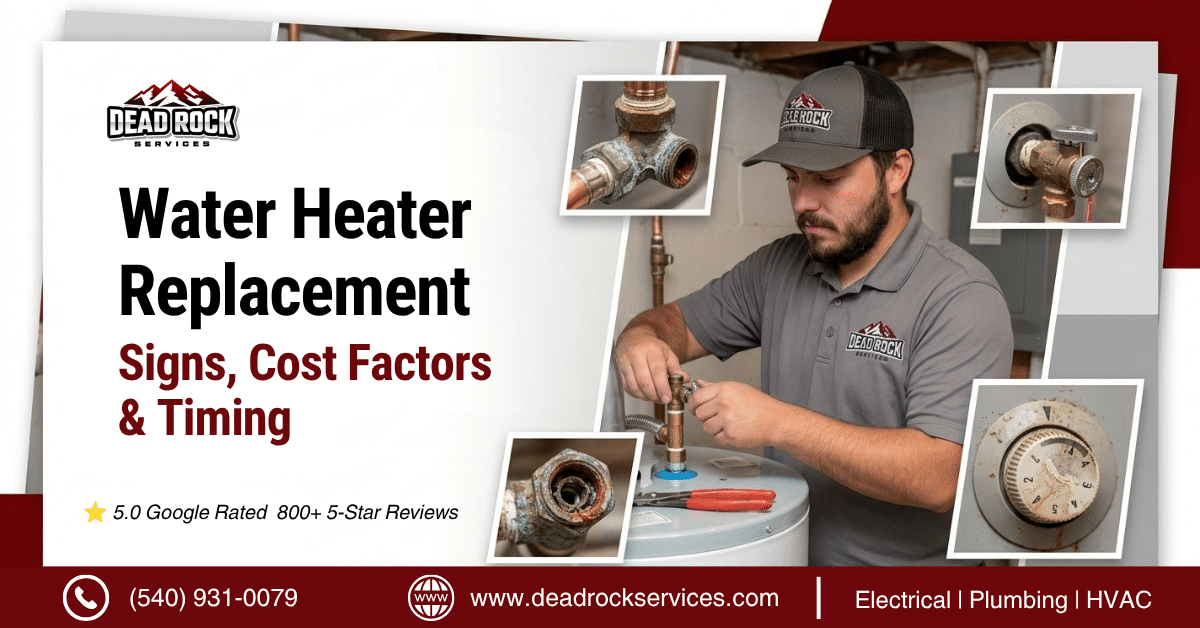
The clearest signs you need water heater replacement are age over 10–12 years, rusty or discoloured hot water, rumbling or popping from the tank, water pooling around the base, and hot water running out faster than it used to. Replacement cost is driven by tank size, fuel type, whether you move to tankless, venting requirements, and any code upgrades the installation triggers. Any active leak from the tank body means replacement, not repair. |
| Last updated: September 2026
Reviewed by the licensed technicians at Dead Rock Services family-owned and serving WV, VA & MD since 2015. Licensed in West Virginia, Virginia & Maryland · Authorized Generac dealer · 5.0 stars from 800+ Google reviews. |
Water heaters rarely fail politely. They tend to go from working to flooding a utility room, and they disproportionately fail in cold weather when incoming water is colder and the tank works harder.
That’s why fall is the sensible time to deal with an aging unit. Here’s how to tell whether yours is near the end, what drives replacement cost, and what your options actually are.
Warning signs you need water heater replacement
1. Age over 10–12 years
Conventional tank heaters typically last 8 to 12 years. Past that, failure risk climbs sharply. Check the serial number on the label it usually encodes the manufacture date.
2. Rusty or discoloured hot water
If hot water runs rusty but cold water doesn’t, the tank is corroding internally. That’s not repairable.
3. Rumbling, popping, or banging
Sediment build-up at the bottom of the tank. It reduces efficiency, causes overheating, and accelerates tank failure. Flushing can help early; heavy build-up in an old tank usually signals replacement.
4. Water around the base
Sometimes it’s a fitting or the drain valve, which is repairable. If the tank body itself is leaking, it’s done and it will get worse, often suddenly.
5. Hot water running out faster
Sediment reduces usable capacity. If showers have quietly got shorter, the tank is losing effective volume.
6. Rising energy bills without a rate change
An inefficient, sediment-filled tank works harder for the same result.
What drives water heater replacement cost
- Tank size and capacity — matched to your household’s actual demand
- Fuel type — gas, electric, or propane, and whether you’re changing
- Tank vs tankless — a bigger decision, covered below
- Venting — gas units may need venting changes, particularly high-efficiency models
- Location and access — a tight crawlspace or attic install costs more than an open basement
- Code upgrades — expansion tank, pan and drain, seismic or strapping requirements, updated shutoffs
- Permit, inspection, and disposal of the old unit
If your electric water heater is being replaced and the circuit or panel is undersized, there may be electrical work too. Because we handle both trades in-house, that doesn’t turn into two contractors and two schedules.
Tank or tankless?
Tankless units heat water on demand, so you don’t run out and you’re not paying to keep a tank hot. They take less space and typically last longer. The trade-offs: higher upfront cost, and they often need upgraded gas supply or venting or on electric, meaningfully more electrical capacity.
Tank units cost less to install, are simpler to service, and work fine for most households. Our honest position: tankless is excellent when the house can support it and you’ll stay long enough to benefit. It isn’t automatically the better buy, and anyone telling you it always is hasn’t looked at your gas line.
What to do right now if it’s leaking
Shut off the water supply to the heater at the valve above it. For an electric unit, switch off its breaker; for gas, turn the gas control to off. Then call. Don’t leave a leaking tank under pressure a failing tank can let go entirely, and the resulting water damage costs far more than the heater.
Extending the life of your next one
Flush the tank annually to clear sediment. Have the anode rod checked periodically it’s a sacrificial part that protects the tank lining, and replacing it is far cheaper than replacing a tank. Keep the temperature at a sensible setting, and keep the area around the unit clear so problems are visible early.
Frequently Asked Questions
How long does a water heater last?
Conventional tank units typically last 8 to 12 years; tankless units often last longer. Annual flushing and anode rod checks meaningfully extend service life.
How much does water heater replacement cost?
It depends on capacity, fuel type, whether you move to tankless, and any venting or code work the install requires. A like-for-like tank swap in an accessible location is at the low end. We provide free written estimates.
Is my leaking water heater an emergency?
If water is coming from the tank body, treat it as urgent. Shut off the water supply and the power or gas to the unit, then call. A failed tank can release its full volume at once.
Should I switch to tankless?
Tankless is a strong choice if your gas supply or electrical capacity can support it and you plan to stay in the home. It costs more up front. We’ll tell you honestly whether your house is a good candidate.